Category: Academic Concepts
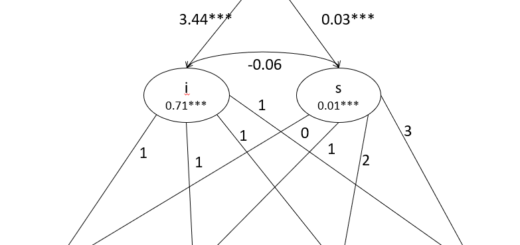
1. What the Growth Model Represents The model tracks national innovation levels across four years: The growth trajectory is captured by two latent factors: Latent factor Meaning i (intercept) Initial innovation level s (slope)...
1. Core idea (one-liner) Theory Core Founding Source Year RBV Penrose – Theory of the Growth of the Firm 1959 RBV Wernerfelt – A Resource-Based View of the Firm 1984 RBV Barney – Firm...
Theory of Absolute Advantage Example:If Norway produces fish more efficiently than Portugal, and Portugal produces wine more efficiently than Norway, both countries gain by specializing and trading fish for wine. Theory of Comparative Advantage...
Layer 0 (Foundation Layer) Layer 1 (Base Blockchain Layer) Layer 2 (Scaling Layer) ✅ In simple terms: Feature Layer 0 Layer 1 Layer 2 Definition Foundational infrastructure for creating and connecting blockchains Base blockchain...
Let’s go step by step so you get a clear foundation in System Archetypes. 🔹 1. What Are System Archetypes? System archetypes are recurring patterns of behavior that show up in complex systems across...
Method Main Use Case Assumptions Handles Time-Invariant Variables Endogeneity Control When to Use Pooled OLS Treats panel data as pure cross-sectional data Assumes no unobserved heterogeneity (all units are identical aside from included variables)...
One should use Generalized Method of Moments (GMM) when: 1. Endogeneity is present GMM is commonly used to address endogeneity, especially when: 2. Model has more moment conditions than parameters GMM allows estimation even...
An instrumental variable (IV) is a tool used in regression analysis to solve the problem of endogeneity — when an explanatory variable is correlated with the error term. A good instrument must satisfy two...
Endogeneity refers to a situation in which an explanatory variable is correlated with the error term in a regression model. This violates a key assumption of classical linear regression and leads to biased and...
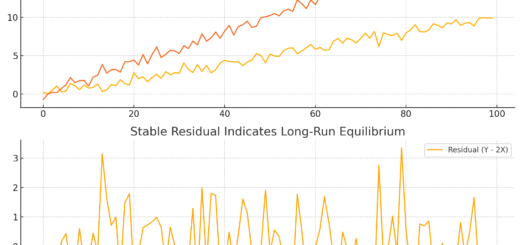
“Long-run equilibrium” in the context of cointegration means: Even though individual time series (e.g., prices, GDP, exchange rates) may drift or trend over time, a certain linear combination of them remains stable over the...